Is there a daily cholesterol limit?
For decades the answer was simple: keep dietary cholesterol under 300 mg per day. That number was part of the Dietary Guidelines for Americans through the 2010 edition, and many websites still repeat it as current advice.
The 2015–2020 Dietary Guidelines removed the 300 mg cap. The advisory committee found the evidence linking dietary cholesterol to blood cholesterol weaker than once thought. It did not say cholesterol no longer mattered: the guidelines told Americans to eat as little dietary cholesterol as practical within a healthy eating pattern. The 2020–2025 edition kept that position.
The current 2025–2030 Dietary Guidelines, published in January 2026, also set no numeric limit for dietary cholesterol. They focus on saturated fat, which they say should stay under 10% of daily calories, and on cutting back on highly processed foods.
The American Heart Association took the same route. Its 2019 science advisory on dietary cholesterol recommends healthy eating patterns, such as Mediterranean-style and DASH diets, over a single milligram target. Those patterns are naturally fairly low in cholesterol.
In short: no current US guideline gives a single daily cholesterol number for everyone. The 300 mg figure survives as the Daily Value printed on nutrition labels, and it is still a practical benchmark for tracking.
How much cholesterol per day: the numbers you'll see
Several different numbers come up when you search for daily cholesterol intake. They come from different sources and serve different purposes:
| Number | Where it comes from | What it means |
|---|---|---|
| Less than 300 mg | FDA Daily Value on the Nutrition Facts label | The reference amount behind the %DV on packaged food. 300 mg = 100% DV. |
| Less than 300 mg | Dietary Guidelines for Americans, through 2010 | The former upper limit for the general public. Removed in 2015. |
| Less than 200 mg | NIH Therapeutic Lifestyle Changes (TLC) program | A stricter target used in diet plans for people with high LDL cholesterol. |
| No set number | 2025–2030 Dietary Guidelines and the AHA | Focus on overall eating patterns and keeping saturated fat under 10% of calories. |
If your doctor or dietitian has given you a number, use theirs. If not, many people use the label's 300 mg Daily Value as a ceiling to stay under. The goal is to spot days that run well over it, not to hit an exact figure.
Dietary cholesterol vs. blood cholesterol
The cholesterol in your blood test and the cholesterol in your food are related, but they are not the same thing. Your liver makes most of the cholesterol in your body. The food you eat adds to that, and your body partly adjusts its own production in response.
That is why dietary cholesterol has a smaller and more variable effect on blood LDL cholesterol than many people expect. Clinical trials reviewed by the AHA found that eating more cholesterol than average generally does raise LDL, but some people respond much more strongly than others.
Why saturated fat matters as much as the mg count
Saturated fat tends to raise LDL cholesterol more than dietary cholesterol does. Many foods high in cholesterol, such as fatty meats, butter, and cheese, are also high in saturated fat. A few, like shrimp and egg whites, are not. Tracking cholesterol in mg is most useful when you also notice where it comes from.
- Plant foods (vegetables, fruit, grains, beans, nuts, and oils) contain essentially no cholesterol.
- Animal foods (meat, poultry, seafood, eggs, and dairy) are where all dietary cholesterol comes from.
- Organ meats and egg yolks are the most concentrated sources by far.
200 mg vs 300 mg: what a daily cholesterol limit looks like
A daily cholesterol number is easier to use once you know what common foods contain. Here is how much of a 300 mg goal (the label Daily Value) and a stricter 200 mg goal each food uses up. Values are from USDA FoodData Central:
| Food | Serving | Cholesterol | % of 300 mg | % of 200 mg |
|---|---|---|---|---|
| Chicken liver, simmered | 3 oz (85 g) | 479 mg | 160% | 240% |
| Whole egg | 1 large (50 g) | 186 mg | 62% | 93% |
| Shrimp, cooked | 3 oz (85 g) | 161 mg | 54% | 81% |
| Chicken breast, roasted | 3 oz (85 g) | 72 mg | 24% | 36% |
| Ground beef, 85% lean, cooked | 3 oz (85 g) | 71 mg | 24% | 36% |
| Butter | 1 tbsp (14 g) | 31 mg | 10% | 16% |
| Cheddar cheese | 1 oz (28 g) | 28 mg | 9% | 14% |
| Oatmeal, beans, vegetables, fruit | Any | 0 mg | 0% | 0% |
Two example days
Day one: two large eggs at breakfast (372 mg), a chicken breast sandwich with an ounce of cheddar at lunch (100 mg), and shrimp sautéed in a tablespoon of butter at dinner (192 mg). Total: about 664 mg, more than twice the 300 mg Daily Value.
Day two: oatmeal with fruit at breakfast (0 mg), a bean and vegetable bowl at lunch (0 mg), and a chicken breast with roasted vegetables at dinner (72 mg). Total: about 72 mg.
Most of the gap comes from just two foods: eggs and shrimp. That is common. A few foods usually account for most of a day's cholesterol, which is why tracking shows where to make changes faster than guessing. See the full list in our chart of foods high in cholesterol.
How to track your daily cholesterol intake
- Read the label in milligrams, not just %DV. The Nutrition Facts label lists cholesterol in mg per serving. 5% DV (15 mg) or less per serving is low; 20% DV (60 mg) or more is high.
- Check the serving size. If you eat two servings, double the mg. Most tracking mistakes are portion mistakes.
- Log food when you eat it. Totals made from memory at the end of the day tend to miss snacks, cooking fats, and second helpings.
- Look up foods without labels. Fresh meat, seafood, and restaurant meals have no label, so use a food database such as USDA FoodData Central.
- Review weekly averages. One high day matters less than a pattern. A weekly view shows whether your usual intake is going up or down.
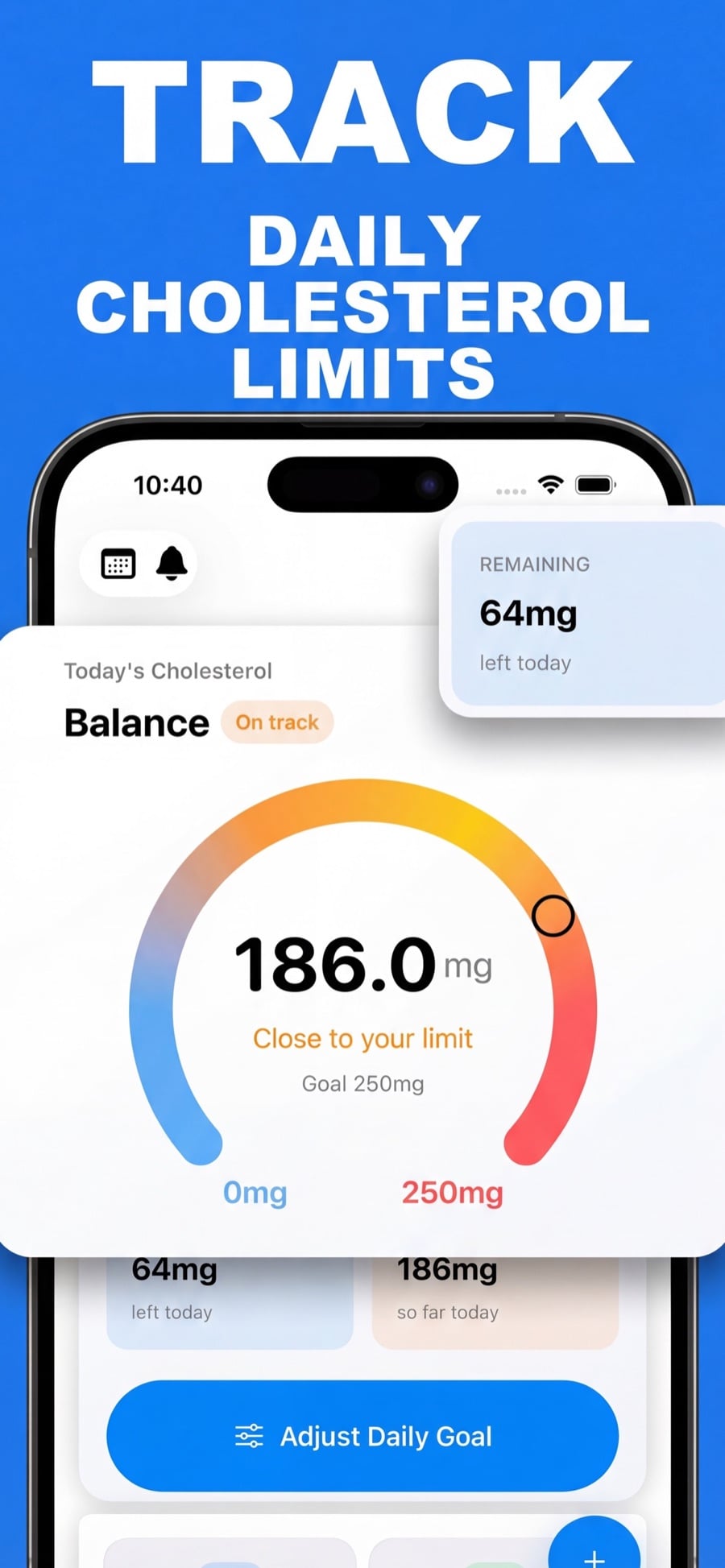
Cholesterol Tracker does these steps for you on iPhone and Android: search foods, scan a meal or a nutrition label, and see what remains against your daily goal. The help guide explains how to set a daily goal that matches the number you and your clinician choose.
When to ask for a personal target
General guidelines are written for healthy adults. Ask a doctor or registered dietitian for a personal daily cholesterol target if any of these apply:
- Your blood test shows high LDL cholesterol or high total cholesterol.
- You have diabetes, heart disease, or have had a heart attack or stroke.
- You have familial hypercholesterolemia or a strong family history of early heart disease.
- You take cholesterol-lowering medication and want your diet to support it.
Bring a week or two of food logs to that appointment. Real intake data makes the conversation about diet much more specific than "try to eat better."
Frequently asked questions
Is 300 mg of cholesterol a day too much?
300 mg is the Daily Value on US nutrition labels and was the official upper limit until 2015. Current guidelines no longer set a single number for everyone, but staying at or below 300 mg is a common benchmark. People with high LDL cholesterol are sometimes advised to aim for under 200 mg. Ask your clinician which target fits you.
How much cholesterol is in an egg?
A large egg contains about 186 mg of cholesterol, according to USDA FoodData Central. All of it is in the yolk; the egg white has none. Two large eggs provide about 372 mg, which is more than the 300 mg Daily Value on their own.
Does eating cholesterol raise blood cholesterol?
It can, but less than many people think, and the effect varies from person to person. Your liver makes most of your body's cholesterol. Saturated fat generally raises LDL cholesterol more than dietary cholesterol does, so both are worth watching.
What does %DV mean for cholesterol on a food label?
The %DV shows how much of the 300 mg Daily Value one serving provides. The FDA considers 5% DV (15 mg) or less per serving low and 20% DV (60 mg) or more per serving high.
Sources
- FDA: Cholesterol on the Nutrition Facts label
- Dietary Guidelines for Americans, 2025–2030
- Dietary Guidelines for Americans, 2020–2025: scientific process and key recommendations (PMC)
- Carson JAS et al. Dietary Cholesterol and Cardiovascular Risk: A Science Advisory From the AHA. Circulation, 2019
- NHLBI: Your Guide to Lowering Your Cholesterol with TLC
- USDA FoodData Central
Not medical advice. This article explains dietary cholesterol in food. It does not diagnose or treat any condition. Ask a qualified healthcare professional about your blood cholesterol and personal targets.